
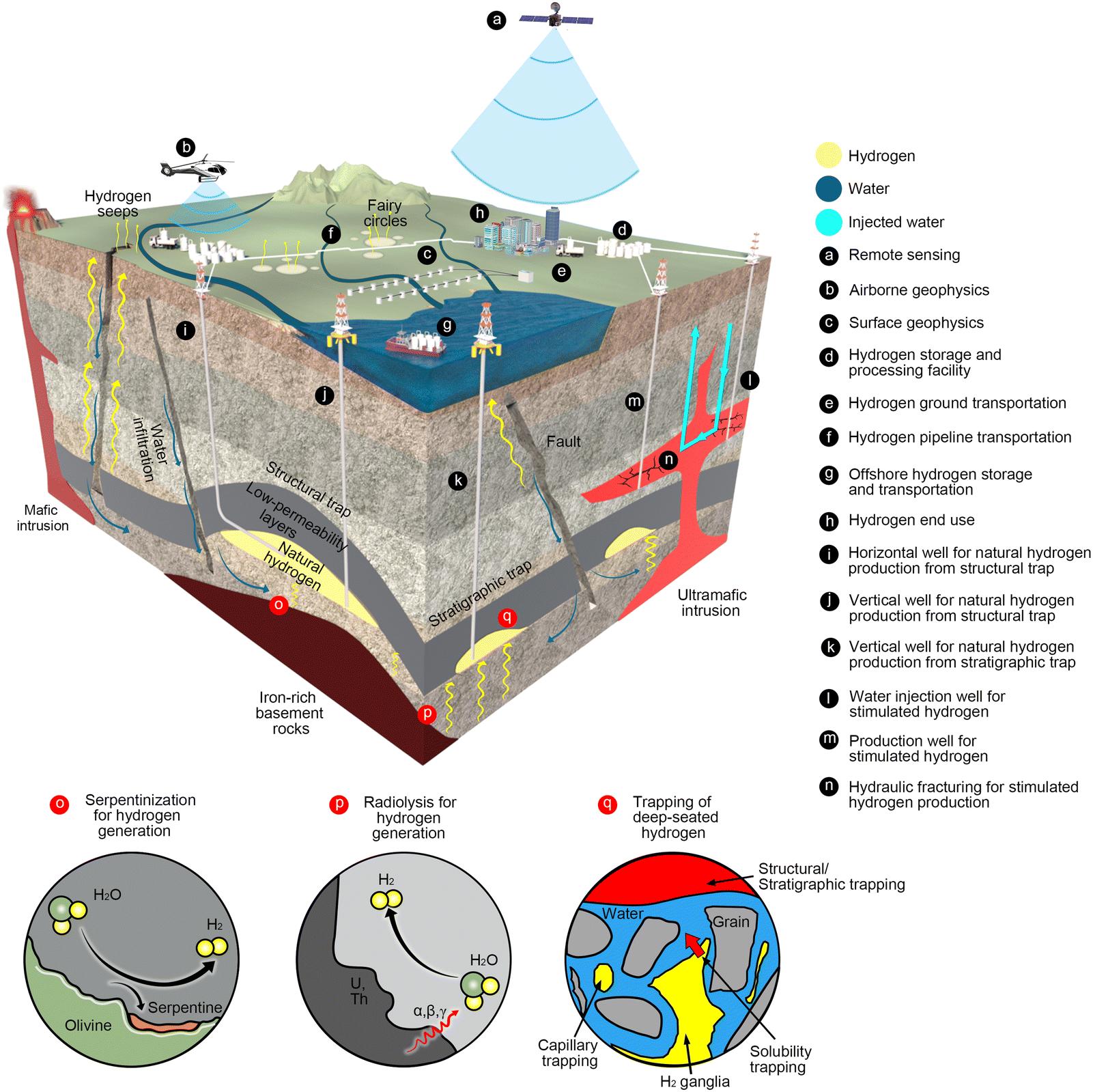
This lesson connects tectonic modeling results with field observations, focusing on natural hydrogen exploration in mountain belt systems. It examines how geological insights derived from simulations are tested through fieldwork, including soil gas measurements and spring sampling. Special attention is given to the Pyrenees as a key natural laboratory where mantle exhumation, fault systems, and surface gas anomalies provide evidence for active hydrogen migration.
1. Field-Based Exploration Strategy
Fieldwork in natural hydrogen exploration is designed to validate whether deep geological processes identified in models are actively producing hydrogen at the surface or near-surface environments. The approach combines geochemical sampling, structural geology, and geophysical interpretation.
The exploration strategy is based on the hypothesis that mantle-derived hydrogen migrates upward along fault systems and may accumulate in shallow reservoirs or escape to the surface as soil gas or dissolved gases in springs.
2. Pyrenees as a Natural Hydrogen Laboratory
The Pyrenees mountain belt is presented as a key study area because it contains exhumed mantle rocks close to the surface, active fault systems, and sedimentary basins capable of acting as reservoirs.
Previous studies in the western Pyrenees identified hydrogen anomalies in soil gas measurements along major fault zones. These findings suggest active migration pathways from depth to the surface.
The geological structure of the region resembles the conceptual model derived from tectonic simulations: mantle fragments are embedded within an orogenic system where fluid circulation is possible, and thermal conditions may fall within the hydrogen generation window.
3. Soil Gas and Spring Sampling Methods
Soil gas measurements were conducted by drilling shallow holes and inserting sensors to detect hydrogen concentrations. In some cases, more advanced mass spectrometry systems were used to continuously monitor gas composition over time.
A more critical dataset comes from spring sampling. Thermal springs in the Pyrenees often release gas bubbles that can be collected and analyzed in laboratory conditions. These samples are particularly valuable because they are less affected by atmospheric contamination and may preserve deeper geological signatures.
Water samples were also collected and degassed in laboratory settings to analyze dissolved gas content.
4. Preliminary Results and Interpretation
Initial field results indicate the presence of hydrogen at several sampling sites, including areas associated with major fault structures. However, the origin of this hydrogen remains uncertain.
While the presence of hydrogen is consistent with the model predictions of deep generation and migration, isotopic analysis is required to confirm whether it originates from mantle-related processes or alternative shallow sources.
At present, no definitive conclusion can be made regarding the source mechanism, and further analytical work is ongoing.
5. Linking Field Observations with Tectonic Models
The field data are interpreted within the framework of tectonic simulations. Models predict that mountain belts should exhibit significantly higher hydrogen generation potential compared to rift systems due to the presence of exhumed mantle rocks in optimal temperature conditions.
The Pyrenees, Alps, and other Alpine–Tethyan systems are therefore considered highly prospective. These regions contain combinations of mantle exposure, fault networks, and sedimentary basins that match the modeled hydrogen system architecture.
Specific examples include mantle exposures in the western Pyrenees, ultramafic bodies in the Alps, and mantle-related structures in southern Spain. These locations are consistent with model-derived exploration criteria.
6. Exploration Implications and Global Targets
Based on both modeling and field insights, several regions are highlighted as exploration targets:
The Alpine–Tethyan domain, including southern Europe and extending into the Mediterranean region, is considered highly prospective due to widespread tectonic collision zones and mantle exhumation.
The Pyrenees represent a key testing ground where previous hydrogen anomalies have already been recorded.
The Alps provide additional opportunities due to exposed mantle wedges and nearby sedimentary basins.
The Balkans, particularly Albania, are identified as emerging areas of interest where active hydrogen migration has been observed in recent studies.
These regions collectively illustrate that hydrogen systems are strongly linked to convergent tectonic settings rather than stable cratonic or purely extensional environments.
7. System-Level Interpretation of Hydrogen Resources
Natural hydrogen exploration is framed as a full system analysis problem, similar to petroleum systems. It requires understanding source generation (serpentinization), migration pathways (faults), reservoirs (sedimentary units), and preservation conditions (temperature and microbial activity constraints).
A key concept is the hydrogen preservation window, where temperatures above approximately 100°C limit microbial consumption of hydrogen, improving preservation potential.
Field observations in the Pyrenees and surrounding regions provide partial support for tectonic model predictions of hydrogen generation in mountain belts. While results remain preliminary, the integration of geochemical sampling and structural geology indicates that deep hydrogen systems may be active. Continued research combining field validation and numerical modeling is essential to refine exploration strategies and confirm the economic potential of natural hydrogen systems.